04 November 2013

If I can't smoke and swear, I'm fucked

"The Shit-Apple doesn't fall far from the Shit-Tree."-Jim Lahey, Trailer Park Supervisor.
We're sailing into a shit typhoon, Randy.
When I taught music at a music store, I met a lot of people.  Mostly teenagers and young adults.  Some didn't give a shit about playing music as much as they did getting rid of their parents and talking to someone they can relate to.  Others really enjoyed playing music, and a few of those really liked heavy metal.  I always enjoyed teaching those students because a lot of them reminded me of myself at that age.

One young man, about 16, was not like me at all, aside from the guitar and interest in heavy metal music. This guy grew up as a devout Catholic, wasn't allowed to listen to heavy metal, had live-in siblings, a father in Iraq, and an overbearing mother.

I was baptized as a Catholic at age seven, I fell from Grace at age eight, listened to everything from Michael Jackson to Burzum at a very young age, and was raised by my father, who had custody of me after he and my mom split when I was two.  My mother only became slightly overbearing after she got off the drugs and started making more frequent appearances in my life.

It wasn't until later I found out that this guy was into murder.
Needless to say, I didn't give a flying fuck that this kid wasn't allowed to listen to heavy metal and over the course of time I taught him the whole Master of Puppets album.  It was an enjoyable time for both of us because I liked teaching music and him because he had someone who wouldn't judge his music choices, since his mother and his school mates often did (he went to a Catholic school).

To top all of the restrictions previously mentioned, this young man was also a homosexual.  And his parents were strict interpreters of the Bible.  He would go on to tell me that his parents hate him because of it, and as a result, he hate himself because of it.

I guess he wound up telling me because I wouldn't think differently of him.

Looking back, it reminds of a quote I heard from Frankie:

"If you don't listen to your body, you'll break your body."
Clearly, the young guitarist was breaking himself if he was having that much hate directed right back towards him.

I really didn't know how to help.  I went through my usual line of thinking:


  1. Leave the Church
  2. Go to a different school
  3. Tough it out til you're 18
I really don't think I could offer much more now, as it were.  On the positive side, he played guitar and they didn't have to hear it all the time, so he could play all the metal he wanted (and he wrote his own too).

I think that we can recall what Rabbi Hillel said to some gentile who was trying to stump him.  Here is my paraphrasing of how I imagine the conversation going:

Gentile: I'll believe you if you can recite this book of yours on one foot.
Rabbi Hillel: Don't be an asshole if you don't want people to be assholes to you.  The rest is commentary. Learn it.

I think a good start to reconcile faith in God and individuality would be to hear that parable often.  I think it would have helped my young student out.


Like me on Facebook


*Title is a quote from the Trailer Park Boys

19 October 2013

Overcoming commitment issues

I get the majority of my grappling content from three people.  GabeKris, and Rob Kahn.  All are technically different as far as their game goes, but they all taught (and still teach) me a fundamentally important lesson for sports and life.

The point is to commit.  Rob Kahn advocates a 70/30 rule, wherein you roll with people you can beat 70% of the time, and the other 30% you go for other far more challenging rolls. Before I started committing I was literally just rolling around with no purpose trying not to get caught in submissions.

In either situation, one must commit to something.  In the 70% situations, you  are doing a few good things for yourself.  The first thing your doing is overcoming obstacles easily to get to your end point.  Psychologically, you are conditioning yourself to win.  Every time you win, you are getting better at doing your reps--the movements that take you to your end point.


As your opponents get better at defending, you will hopefully get better at overcoming obstacles as they occur more frequently and defensively.

For the jits, I like to give myself the following checklist.  I don't actively think of it in list form during rolling, but it's there. The list is as follows, if I am starting in guard:

  1. Sweep
  2. Pass
  3. Get control in a dominant position
  4. Work the submission
If I start in someone else's guard, the first step is taken out.

Initially, this will not work 100% of the time.  You'll go to pass, and fail or get caught in a submission.  You won't get the sweep, or you won't lock the submission correctly.  That's ok.  One of the things Kris emphasises to me is that he worries about his own shit and not what the other person is doing--when he goes to pass the guard, he gets the limbs out of the way to get the position and gets the pass, while the opponent is doing their thing.

From Gabe I learn to accept and get into positions in a way that leaves me calm and not in a frenzy.  I can't emphasize this enough for a beginner: don't go apeshit if someone gets you in side control or full mount.  Let them move, let them fuck up and capitalize on it.

Among these four steps listed, learn a few different ways to accomplish the goal.  If one pass doesn't work, do the other one.  If it gets defended, go back and forth and land the damn thing (whichever one you end up going for).  In one of his after class speeches (which he swears none of us ever listen to) Rob will always ask who the better person will be--the one who went for 200 arm bars in a year of training, or the person who backed out, didn't engage and didn't go for anything (I listened, Rob).


One of the final pieces that I don't do nearly enough of as specifically as I could comes from Frankie.  Use the rolling to find out your weaknesses, and drill them so they aren't so weak anymore, while using the minimal effective amount of effort.  Use the 70/30 method, you will have a good cycle of training ahead of you.

If you follow the 70/30 rule, you'll get better at not getting caught while being an active player in your own jits game, and you will land the passes, and what not provided you commit to them.  Don't stop the pass at the slightest indiscretion and give up.  You won't have a clean rep of what you want to do.  These steps helped my game out tremendously and will do so for you, most likely.


Like my goddamn page

11 September 2013

Training the pianist

I don't know why I didn't think of this sooner, but better now than never, I suppose.  A friend came to me with an exercise related question, and being the guy I am gave great advice that turned out to work in her favor.

I then had the stroke of genius to help all of my musician friends by writing this post.

Valentina Lisitsa plays one of my favorite renditions of Beethoven's Moonlight  Sonata
One of the guiding principles of The Movement is working within our limits to expand them.  This is preferable as opposed to trying to do some shit you may or may not be able to do and risking injury.  Without having met Valentina, let's use what we can figure out as a starting point to help out with training piano players.

First thing is first.  She is a concert pianist.  spends a good portion of her life in the position above--flexed/translated neck, flexed hips, knees and shoulders are the obvious examples.

If you are a piano player, here are some things you might consider as starting points for your training.

If your movement quality is really shitty, you might try push ups done on your knees (also called girl push ups though I am not a fan of the term).  I suggest these to work out the arms first, and focus on extending the wrists, and elbows in the event that you might be too limited to mess around with anything else.

If you're extra fucked up, you might try using the machine to do some partial rows and work up to full rows (starting from full extension and pulling back) and then moving towards the knee pushups.

From there, perhaps full pushups with the body straightened and/or goblet squats to parallel or higher depending on how you sit on the piano bench.  Better, us a bench/box at the gym to figure that out.

Sara Daneshpour playing Tchaikovsky
This is by no means a definitive list on how to train if you are a piano player.  I just made the hypothetical assumption that the player is untrained and started from there.  Depending on your age, activity level and time spent playing, your mileage may vary.  Stay tuned for more.


Like me on Facebook

23 August 2013

Traditions might fucking kill you

Buy this shirt. Or at the very least, look on it and laugh.  It's a more specific sentiment on traditions.  I don't think they all are useless.  But they should be critiqued.


Here's a good one: the father giving the daughter away at a wedding.  Back when women were property and people worked all the time, the family of the daughter had to get rid of a valuable, working piece of property.  The bride price was paid, the daughter was effectively sold to another family.

Warming up is one directly related to lifting.  In fact, I have talked to no less than five people, in person, who have fucked their shit up doing a warm up set.  Some had it worse than others.  Often unquestioned, yet is it still worth it?

Poor bastard took his warm up too seriously
The latter tradition is one that's testable, thankfully.

I'll keep this brief.  There's all sorts of shit to question.  Depending on your sport, you can question a myriad of things to a great extent.  For lifting, here are some questions you can ask first:

Can I do my goal movement today?
Can I PR in it?
Can I do it more often?
How will I be able to attain the ability to do it more often if I can't?
Can I run myself or should someone else tell me exactly what to do?

The less adaptable you become, the less movement you create.  You know what happens next.


23 July 2013

A few pullup variations so you don't get bored to tears.

Last year when I couldn't deadlift much, I did a fuck load of pull ups. I only did two variations, but the best part was that one expanded my range of motion--I was able to do wide grip pull ups and not fuck my shoulders up.  Many people also have lofty pull up goals. Hopefully these will help.


Around this time, I was doing pull ups 2 to 3 times a week, and as a result my volume and intensity escalated quickly.  Needless to say, I had to ask myself what was next.  Some of the following I have seen from Adam, and others I concocted on my own. 

Towel Pull ups:


It's pretty simple. Take the towels, loop them over the bars and grab the damn things and do some pull ups.  This is a good way to train your grip, and though I am no Adam, I get the feeling everyone can benefit from grip training.

Rolling Thunder/Vertical Bar Pull ups
These are pretty cool.  If you have two vertical bars, you can use 1 for each hand.  These are great because most movements with barbells don't allow for ulnar deviation, and both the vertical bar pull up and the vertical bar deadlift allow that position to be trained.  Another option is to use two rolling thunder handles.  I have one handle and one loading pin, hence the set up.  Another option is two hands one one vertical bar.

Eagle Loops:
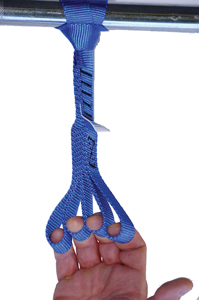
That is an eagle loop. They come in pairs from ironmind.  You can also do pull ups with these, and concentrate on individual finger groups, if it suits you.  My favorite thing to test is an eagle loop and a rolling thunder handle.  Find the variation that tests best for you.

Crush Pull Up:


I like to get better at clinching by clinching, so I call this the crush pullup because you have to crush the shit out of the kettlebell to do it.  Instead of taking the intensity out by using a rubber bell, use an iron bell.  I like using dragondoor bells since they have different sizes.  The bigger the bell, the more difficult it is.  Use a lot of chalk.  Also, the closer your finger tips the easier they become.  Plan and test accordingly.

The options are limited by your imagination, and this is not a complete list.  The important thing is to test your variation, and find which is best.  The more often you can do a pullup, the better you will get at them.

27 June 2013

Non Specificity and You

But first, an aside:

People are going nuts about the history changing shit going on in Washington (be it nefarious, or otherwise).  People are going nuts about celebrities and personalities who have little to no stake in how much better you can be. 

I will pose some questions for you to mull over regarding these issues. 

Does the fact this fat bitch called someone a "nigger" really matter in the context is being made out to matter? Does it affect you negatively in any way?

I grew up in a redneck town called Plant City.  We have a lot of strawberries, and a festival dedicated to them, wherein washed up country stars play to a moderate sized venue.  We also have a lot of racists, rednecks, Black people, and Mexicans to go along with the predominantly white population. 

Back to the question at hand.  Yes, it matters if you use racial slurs in a hateful context.  It makes you appear to be a racist asshole.  Is being a racist asshole the best way to develop yourself as an individual? Probably not. 

Does it matter that this woman said it? No.  In my hometown alone I can encounter hundreds of fat, old white women who have comparable cooking skills who call Black people "niggers," Mexicans "spics," and any other horrendous things you can think of.  I have also witnessed my Black cousin be verbally assaulted by other residents of my town.  Why should you give a shit about a famous one? I don't think it's a good use of time.  At least if I encounter the ones in my community who behave the same way, I could at least have some influence on them and help lead them to a better place regarding their ingrained racism.

This just in: DOMA got defeated.  Why is this an issue? Oh wait, because somewhere along the way the religious people who give a shit about marriage let the state take control over it.  We let the state infiltrate something personal--again.  You lose.  Not only do you lose because you relinquished your control of a dated institution, you lose because it was never your own dated institution to begin with, since it predates Jesus, The Bible, Christianity, and Judaism.   You lose because its now a federal matter.  Since I can't have my way and get rid of this nonsense and our funding of it altogether, suck it up and accept the fact that homosexuals can finally come closer to having rights of the rest of us so graciously given to them.  Is someone else's marriage really going to affect you? I mean aside from the fact you can't free load on alcohol.  All I want is one good argument not based on religion as to why only some people can get married and others can't.  At this point in time, nobody has been able to deliver one.

I guess this rant brings me to what I wanted to talk about in the first place.  I wanted to address contra specificity/non specificity. 
If you find yourself falling in the same traps repeatedly--like maybe you support famous racists, or hate the fact that people are getting equal treatment--you might want to act differently than you already do.  It might be stressful, at first.  But the result might be worth it. 

In the testing model, we try to be as specific as we can, first.  Then we move towards contra specificity and non specificity.  I am a big fan of the latter.  From a movement perspective, it has helped me relieve pain I spoke of before, and it has helped me gain flexibility.  The non specific activity being Jiu-Jitsu, of course.  It has also helped me relax more. 

Another way I like to practice non specificity is when Arielle and I go out to eat.  I am not a picky eater, so I have no qualms with telling my server to surprise me with any dish from the menu, with few parameters.  It gives me new ideas to implement at home, lets me know I like things I didn't think about trying before, and it saves time and decision making.   I have not been let down yet, and have loved all the strange things given to me.

This idea can especially apply to relationships of any kind.  Especially those that stress out.  I had a friend who had MS.  It was a stressful task to prepare to even talk to him on the phone, given the gravity of topics we would talk about.  I would literally have to plan time to talk and set it aside so I couldn't do anything else.  Of course, it was a huge pain in the ass for me, but even though the stress built up because of the fact that it wasn't something I would normally do often, the relief of going through with it was worth it, even though it was a distressing activity. 

So, think of people you think you need to talk to.  People you might need to apologize to.  It might stress you out, but the end result will be worth it. 

Lastly, one of my favorite ways to do non specific things is to learn multiple routes to get to and from home and what not.  I found the plus sides to be that I can find cooler gas stations (perhaps cheaper, too), cooler landmarks, eating establishments, and I can avoid the stress of traffic--which is absurd to get stressed over to begin with, even though I do all the time.

Add some contra/non specificity to your life. You might be glad you did.

07 June 2013

Honoring your mentors: The Greater Implications of 'Smashing the Head'


I got into training for stuff because I got tired of being a lazy fuck.  I did not know that I could later apply the principles (and with greater accuracy on down the road) to the rest of my life.  I am pleasantly surprised and delighted that I can (and do).


Rob Kahn: Owner of Gracie Tampa North, and  Royce Gracie black belt
 Recently, I started thinking about something Rob Kahn (above) says often--so often it's the tag line for the Gracie Tampa shirts.  "When in doubt, smash the head," or some variant. The rationale being that the one who controls the head will control the fight. 

I make it a point to take Rob's classes whenever I get the chance, and true to form he focuses on controlling the head whenever possible. 


One of the neat things about Jiu Jitsu is that it involves an opponent.  In powerlifting, your opponent is mainly yourself and an unmoving object. Metaphorically speaking, in powerlifting you will inevitably (and metaphorically) smash your own head if you are not careful.  In Jiu Jitsu, you can either smash or be smashed. 

Like all physical endeavors I now undertake in, I like to apply head smashing to my way of being.  Figuratively speaking, every interaction we engage in with people we are engaging in game theory.  In many of the interactions we engage in we are impressing our will upon another human.  This happens actively, passively, to a greater extent, and to a lesser extent, with all sorts of nefarious and benign intentions in between.

Depending on the situation you are in, learn how to psychologically "smash the head."  Learn to do so in many ways, and learn to defend your head from being smashed so you can come out victorious in your interactions.  This is one of the best grappling lessons I have learned from Rob Kahn to apply off and on the mat.