12 April 2012

Individual Thought Patterns: Guest Post by Darryl Lardizabal


Editors Note: I wrote about this concept here after a conversation with Darryl and then went on to give this a try, and my results got better from it.  Practically speaking, I wasn't wasting time dicking around testing weights and expending undue energy.  It also saves time.  As another experiment, I am having a friend try it out, and she is a complete blank slate when it comes to a lot of exercise movements, though not a complete novice.  I have also ventured out to testing new movements to success as well, and some movements I wrote off due to old dogmatism--I recently did direct tricep work and lat pulldowns.   At the end, check out Darryl's website and his stuff.  He asks interesting questions and they might give you new ideas.

Introduction
Mental testing?
Think it's impossible?
It's not necessarily something you first starting doing is it. Most of us that do Biofeedback testing have in some way begin to experiment outside of just testing exercises. Some have begun testing food, others something else entirely.

Some of my first questions were:
Can I test my thoughts?
What will begin to happen when I begin testing my thoughts?
What changes will happen if I begin to do so?


The original question came about while I was exercising. Frankie Faires often says, “Test Everything.” But one of the biggest questions that comes from that is “What is everything?” and “What isn't everything?”

So as I began exercising I came up with a simple question. Do I really have to do the movement to test it or can I think of the movement and get similar results to when I do it?

So I begin a little thought experiment. Think, test, do.
For example: Think “Can I deadlift.” Test. If it tests well, do it.

It seemed to work.

When This Seems to Work WORSE & What You Can Learn from It
Before I go over how this seemed to work better, let's go over why I don't prefer this method for beginners; and what I'd prefer you do, if you decide to try it.

I think of testing as a way of data acquisition. Basically, a way for your body to gather data on what tends to work well per second, per hour, per day, per week, etc. What seems to happen as explained by Frankie Faires in his Biopsych course is we begin to have better associations of what is and isn't right for us at the moment. With these better associations, we then keep getting better and better at figuring out who we are – physically, psychologically, and chemically.

When you test for things and they turn out better, you understand what TO DO [at the moment].
When you test for things and they turn out worse, you understand what NOT to do [at the moment].

In the beginning, mental testing seems to be influenced heavily on “ONLY” your beliefs at first, but when you begin testing both mentally and physically – your beliefs tend to better match YOUR reality: what actually works for YOU.
For example: If you've deadlifted before and have done so multiple times, when you test for deadlifting by just thought; most likely you will be more accurate on if it tests well or not.

On the other hand, say you haven't been deadlifting, especially more recently or you are new to deadlifting in general, and you decide to test for it (only mentally); you have a better chance at having the “wrong” belief.

On a personal note: There were times during this mental experiment that led me to pursue an exercise, and it just didn't feel right when I did it. Sometimes it would put me into pain, other times it would completely ruin my state.
For example: I thought I should deadlift. It tested well. Then I did it and it hurt me or just didn't feel right to do. I ended up either in pain or with no PR in intensity/density/volume.

But was I wrong? I don't think so. But I had to ask my question better. What was wrong and what was I actually testing?

What was wrong and what I may have been testing seemed to be my personal beliefs on the issue. Those beliefs have served me before, but something may have changed at the moment to make that belief somehow worse for me at the moment. In this case. Thinking I should deadlift and it hurting me may have some other associations I didn't have before: For example: Prior deadlift days may have been on days where I was well rested and possibly on this day I wasn't. Another example may be I may have had more mental stress (from running my business, writing blog posts, studying online courses, etc) that affect my overall bodily function overall.

Using the Wrong, To Make It More Right
Since then I've reformatted this thought experiment depending on what I'm testing and how “new” it is to me.

Anything new:
Think
Test
Act
Test

Anything “older;”
Think
Test
Act

This formula isn't set in stone!

What constitutes new or old?
New is a relative term because new is based off of you, so is old. Some exercises you may have been doing for 6 months and it may still be “new” to your body.

I've started to judge “new” by “Intuition.” For our purposes, intuition is when you start to feel like you want to do something.


Intuition will help you govern what seems to be new or old. The general idea is if you still don't know if you should or shouldn't be doing something yet, that exercise is still “new” to you. On the other hand, an exercise seems to be old when you start to have some indication PRIOR to doing that exercise if you should or shouldn't be doing it yet.

What do you mean this formula isn't set in stone?
This above formula is highly based on what you feel like you should do. In general if I want to make sure something is “right” I will do the “Anything New” formula.

Anything new can be:
Any new Macromovement
Any new Micromovement
Any new Micromovement Modification within a Macromovement
Any new Macromovement Modification within a Micromovement
Any new Micromovement Modification within a Micromovement
Any new Macromovement Modification within a Macromovemnt

You be the judge of when you want to recheck, I would say recheck when you feel like it or whenever you are unsure of yourself.

If you continue going down this route you'll have a better overall predictive abilitiy (better intuition) in terms of anything you've been testing.

For example: If you've been testing deadlifting, front squatting, bicep curling, bench pressing, and overhead pressing; your ability to judge when you should or shouldn't do them will get higher and higher as you continue on. On the other hand; anything you haven't been doing in awhile will more than likely get lower and lower as you continue on, until you start doing them again.

How Fast Will I Gain Predictive Abilities?

With the typical formula: test exercise, do exercise; the predictive abilities seem to be slower than when you mentally test the exercise, do the exercise, and retest, then continue to do the exercise as long as it tests well.
 
My predictive abilities came slower than when I taught a similar formula to my clients. There was also a difference in speed between those who did the mental version over just the solely physical one.

So What Is Exactly Going On?
First of all. I have no idea what EXACTLY is going on.

But I do believe.

What I believe this method does is better map your mind to your body, rather than mapping your body to your mind, something Frankie Faires says we want to be trying to do – if it tests well. Why I believe this method works better is because you're “directly” testing your beliefs and rechecking it with the “truth.” Your belief of a how say a deadlift is good for you, you do it, and it turns out it isn't; helps form a better representation of what your body really wants.

I don't necessarily think you should or shouldn't be doing this, but my overall goals are to see how far I can take testing by following Frankie's simply motto: “Question Everything, Test Everything.”


Darryl can be found in “The Play Pen”, editing videos of himself playing with himself or with his clients, training his clients for Pure Greatness, or writing smart ass articles on http://www.easierstrengthtraining.com/. If you’d like to contact him: E-mail him at apolakifitness@gmail.com, friend him on facebook: Darryl Lardizabal, or twit him @XPO312.



16 March 2012

Your Back Hurts? Quit Fucking Whining and Fix It, Part 4

 Read these:

Part 1
Part 2
Part 3
Part 5 (read this one after you read the current post, in case you cannot count)

This time, my back hurt.  It hurt pretty fucking bad for a while.  I was practicing front squats on a distress (day where you do not strictly follow GM protocol) day and did not stop when I should have.  What started as a manageable tweak, turned into something horrid.  The back pain erupted into something worse.  It was aggravated by sitting down in my work chair.  I would notice that when I stood up after sitting for extended periods, a sharp searing pain radiated from my ass to my foot, and it hurt like hell.  I had never felt this way before, so after a week of not moving, and still hurting, I started to worry.   I opted to use a doctor as a last resort, and in the mean time fucked around with other ideas.

Idea one was simple.  Stop sitting at work.  I did that.  Shit felt better immediately (but still really fucking hurt).

It was my sciatic nerve that was fucked, by the way
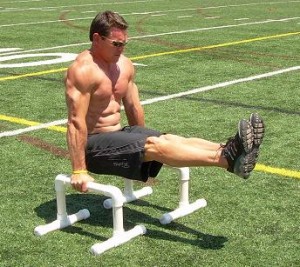
Other things that provided temporary relief included anything involving an L-Sit.

This is an L-Sit

This was a good idea, and always tested well.  A problem I was still having however, was that by even doing a bodyweight squat, my left leg felt like it was having an earthquake, and that it couldn't support my body.  This was no good.

I then decided to look into massage therapy.  A good friend of mine, Nyssa Hanger, happens to be someone I trust, and a massage therapist.  I went to her first, because I have known her for several years and as such, I trusted her.  She recommended Structural Energy Therapy, which is a structural realignment based on your current structure.  I was interested, but ultimately didn't give a fuck to learn the details until after I felt better.

Nyssa Hanger, contemplating the infrastructure.
It was pretty interesting, what I learned during the first session.  What was more interesting was the fact that after the first session, I gained a fuck ton of leg strength back and was able to start squatting again.  Yay. No more quaking left leg.  The pain had decreased a lot.  I tested whether I should get another one, and got a green light.  Even less pain the second time around.  Sitting did not hurt as much.  Though, I don't sit at work anymore I still sit on the couch at home or lie down.  During the most intense periods of pain, lying down always helped as did standing.  Now, I am able to front squat, back squat, and safety bar squat again.  A third massage did not test well, but now the pain is a half inch away from non existent.

The massages were only one step to my pain resolution.  Being in the situation forced me to think of other things to do to help the pain.  Bridging, static stretching, using a stairmaster, and asymmetric lifting all tested well.  At one time, static stretching and the stairmaster never tested well.  But this time, stretching the everliving fuck out of my hamstring (by way of a toe touch stretch and downward dog yoga moves) helped me out immensely.  As the pain got better, the amount of stretching decreased.

I have no reason to believe I won't be able to compete at the next powerlifting meet I signed up for, now.  Prior to my resolution, I was deathly afraid I wouldn't lift again.

On a positive note, I didn't lose strength, and could wake up any given day and be ready to compete at 181 with no cutting, so there is a ten pound weight reduction.  I have since decided to compete at 165.

I still stand at work, and have also switched to barefoot shoes--Vibram Five Fingers (because I am a tool) and Merrell Tough Glove barefoot shoes.  Both of these brands are rad to lift in and have helped me keep the better alignment Nyssa helped me achieve.

I will also add that I got a shitload of reading done.  I read Stieg Larsson's Millennium Series (which includes The Girl with the Dragon Tattoo).  It was fucking awesome.  I also finished the first book of The Hunger Games.  It was also fucking awesome.

I know it sounds like I was whining here, and I probably was.  This is the most hurt I have ever been in my life.  The take home points are several.  First and foremost, unless you're about to break a world record, fucking stop moving if something hurts.  Two, don't do what I did as far as treatment, unless it's right for you. Three, the sciatic nerve, like the Wu-Tang Clan, is nothing to fuck with.  Hopefully, this will help someone out there.  And there you have the first three months of my new year since about my birthday (16 January).

06 January 2012

The Racism of Ron Paul

I intend to volunteer for the Ron Paul campaign when he heads to Florida for his primaries.  I almost voted in 2008, but never got around to it because, by the end of election Tuesday, I was convinced that the system was bereft of anything worth a shit as far as ethical standards go.  Two 'opposing' political parties with 'differing' policies that allowed a corrupt system to stick their fingers up our proverbial asses and point us to where they wanted us to go. 

Recently, I decided I liked what Ron Paul had to say.  When I made vocal my opinions (as I am wont to do) several people I have high amounts of respect for called me out and told me that Ron Paul was a racist.  However, these same people who called me out and provided their rationale are the same people who helped direct me to think for myself in my formative years.  Needless to say, with good conscience, I cannot berate or blast them as I can any other faceless asshole on the internet, since I know and respect these people as friends and human beings.  One compelling strategy to prove Dr. Paul as a racist is to go straight to the primary source--his own writings.  In Freedom Under Siege, Paul states:

Today's current terminology describing rights reflects this sad change.
It is commonplace for politicians and those desiring special privileges to refer
to: black rights, Hispanic rights, handicap rights, employee rights, student
rights, minority rights, women's rights, gay rights, children's rights, Asian-
American rights, Jewish rights, AIDS victims' rights, poverty rights, homeless
rights, etc.(22).   
On the outset, this seems like a good idea.  But from a standpoint of individualism, it's bound to bring about more problems.  Philosophically, whether these ideas are social constructs or not, is it not relevant as long as there are still categories for them extant.  By virtue of the category, it perpetuates the problem of bigotry (which is in and of itself a product of categorization that we impose on ourselves and others). 

Moreover, it is easy to misinterpret quotes like that when you read quotes that state that, "[t]he individual
suffering from AIDS certainly a is victim -- frequently a victim of his own lifestyle -- but this same individual victimizes innocent citizens by forcing them to pay for his care (Freedom of Siege 31)."  It is patently unfair to refer to the previous quote as being bigoted.  For one, Paul did not say the AIDS patient is always  a victim of their own lifestyle.  Anyone knows that isn't true.  People get raped, and forced into situations without consent and the consequences can be disastrous.  However, we also know you can get AIDS and other diseases from your own choices--like fucking whores and sharing heroin needles without cleaning them.  So is it really a misnomer to say that they are frequently the victim of their own choices?

Victim of their own way of life?


Then there is this picture
Ron Paul hanging out with Grand Wizard of the Ku Klux Klan Don Black.  The context we have regarding their relationship is a donation made to Paul's 2008 campaign.  And Don Black Stating that he doesn't believe Paul to be a white nationalist.  Whether you can take this guy seriously, or not, is of secondary importance.  One important thing about both the picture, and the video is this: if you are a politician representing the people, you can't pick and choose who you want to represent.  If people identify with your message, to a degree, you do not always have to identify with other aspects of their beliefs.

Another argument for Ron Paul as a racist stems from the previous paragraph.  He voted against the renewal of the Civil rights act of 1964.  Controversial, I know. Taken from his website, to defend his vote he states

Mr. Speaker, I rise to explain my objection to H.Res. 676. I certainly join my colleagues in urging Americans to celebrate the progress this country has made in race relations. However, contrary to the claims of the supporters of the Civil Rights Act of 1964 and the sponsors of H.Res. 676, the Civil Rights Act of 1964 did not improve race relations or enhance freedom. Instead, the forced integration dictated by the Civil Rights Act of 1964 increased racial tensions while diminishing individual liberty.
The Civil Rights Act of 1964 gave the federal government unprecedented power over the hiring, employee relations, and customer service practices of every business in the country. The result was a massive violation of the rights of private property and contract, which are the bedrocks of free society. The federal government has no legitimate authority to infringe on the rights of private property owners to use their property as they please and to form (or not form) contracts with terms mutually agreeable to all parties. The rights of all private property owners, even those whose actions decent people find abhorrent, must be respected if we are to maintain a free society.
This expansion of federal power was based on an erroneous interpretation of the congressional power to regulate interstate commerce. The framers of the Constitution intended the interstate commerce clause to create a free trade zone among the states, not to give the federal government regulatory power over every business that has any connection with interstate commerce.
The Civil Rights Act of 1964 not only violated the Constitution and reduced individual liberty; it also failed to achieve its stated goals of promoting racial harmony and a color-blind society. Federal bureaucrats and judges cannot read minds to see if actions are motivated by racism. Therefore, the only way the federal government could ensure an employer was not violating the Civil Rights Act of 1964 was to ensure that the racial composition of a business’s workforce matched the racial composition of a bureaucrat or judge’s defined body of potential employees. Thus, bureaucrats began forcing employers to hire by racial quota. Racial quotas have not contributed to racial harmony or advanced the goal of a color-blind society. Instead, these quotas encouraged racial balkanization, and fostered racial strife (emphases his own).
The argument here is about private property.  And it pains me to say that it is really easy to see why the Derek Vinyards in the world can identify with such a philosophy. 

Derek Vinyard
If the Federal Government would take pains to promote this act, then it should tell Downsize Fitness that they have to allow all people, not just fat people to join their gym.  And it should intervene in the privately funded religious secondary schools, and colleges in America as well.  

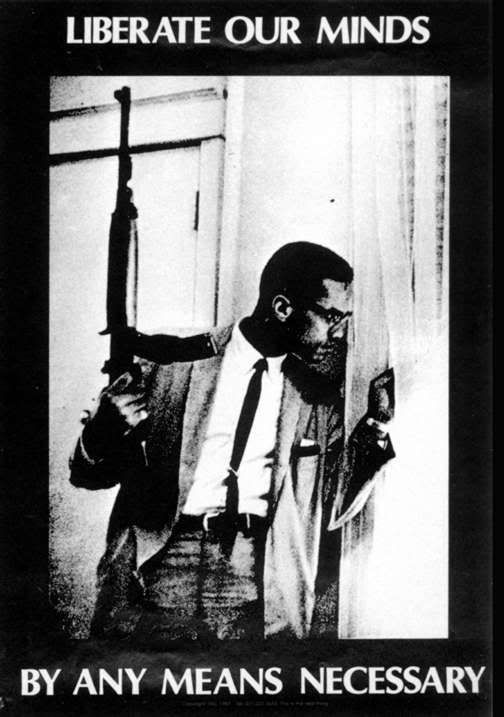
As a hypothetical situation, I can see a guy with the beliefs of Malcolm X supporting the view of a guy like Ron Paul.  Both of them believe in forms of slavery still existing, regarding debt enslavement, and enslavement to the promises of someone holding authority over someone else.  Malcolm X called those blinded by the shiny promises "house niggers." 

Both Malcolm and Ron Paul have a system of resistance that is civil and disobedient (not in the same way as Thoreau and Martin Luther King Jr.) in that they believed in gun ownership to protect your individuality.  Malcolm X along with the Nation of Islam were targeted by our government often with acts of disinformation, and one way to counteract that was to defend themselves (not commit wanton acts of violence). 


Moreover, in his life, Malcolm X was criticized as racist, homophobic and anti-Semitic.  Much like Ron Paul.  But to be fair, Ron Paul was not the only one critical of the civil rights act and the economic system. The good stuff is halfway through the video, where Malcolm talks about how it doesn't really open up new opportunities for blacks in America.


The main problem I find with the "No" vote on the civil rights act is that he doesn't provide a solution, and acts as though with time, people will become understanding all of the sudden. As if, I, a business owner will suddenly awaken and say, "Maybe I SHOULD let everyone that I never allowed before inhabit my business now." Common sense (which he overestimates its abundance in the American People) says that any smart business owner wouldn't discriminate that way because it's bad for business. And though some would realize that, not all would. That's one flaw of his thought process. But, in accordance with his extreme anti-collective lines of thought, he'd be more of a hypocrite if he voted yes on something like the civil rights act and tried to give it some lame bullshit justification.  For such consistency, we should give laud as it is a rare trait in any American politician these days.  


At the end of the day, I can see why racists like the guy's view points.  I could go on about it, but there's no need.  I gave you some primary sources, youtube has a shitload of interviews of him speaking his philosophy, and if you're not an idiot, you can form your own opinion, which I hope you will.  In the end, I can see a guy who just wants to stop fucking with cultures we couldn't begin to comprehend, and who just wants to unfuck our country.  Let the flame wars begin.